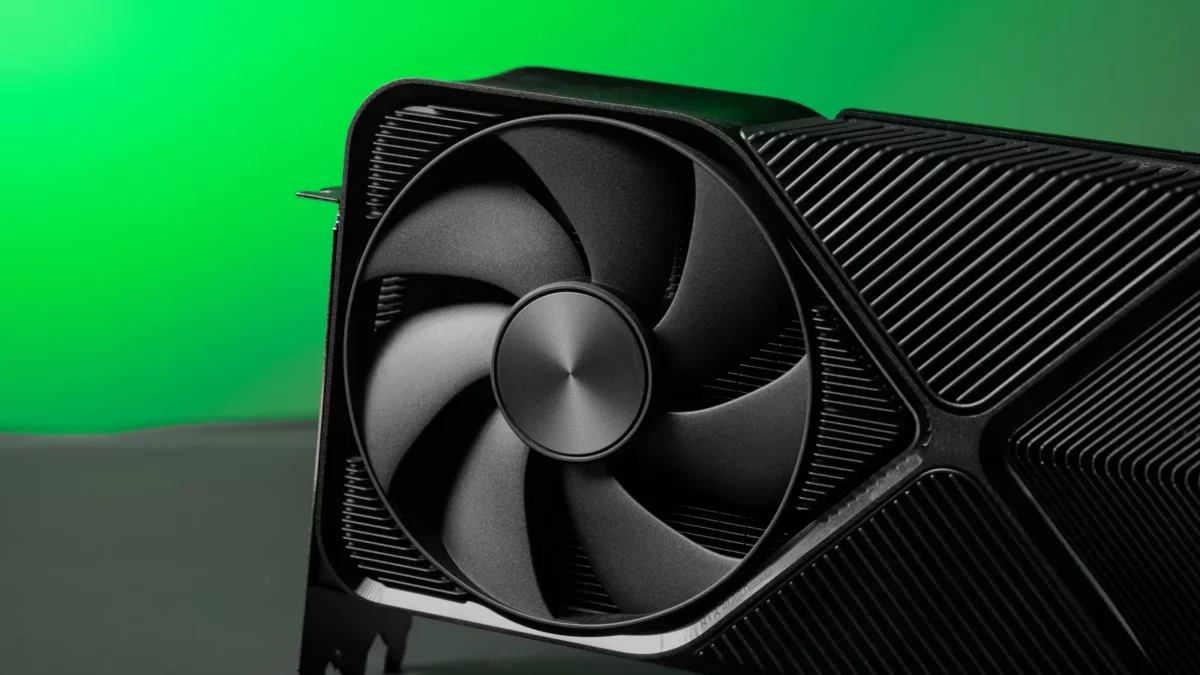
Ever wondered why the GeForce RTX 5090 is impossible to find at anything close to its launch price? New photos circulating from Hong Kong offer a blunt answer: entire pallets of retail gaming cards are being unpacked and slotted into AI servers, in bulk, before a single gamer ever sees them.
What the photos show
The images, shared by HKEPC on X, depict a workspace lined with pallets of brand new retail RTX 5090 boxes. Workers unpack cards bearing the retail branding of board partners like MSI and GIGABYTE and install them into multi GPU server chassis. These are not NVIDIA’s RTX PRO 6000 workstation cards, the ones actually designed and certified for server duty. They are the same gaming cards you would find in the graphics card aisle, if the graphics card aisle had any.
One detail stands out: the cards in these photos are not even the RTX 5090 D, the China specific variant NVIDIA deliberately nerfed for AI workloads. The 5090 D delivers 2,375 AI TOPS compared to the standard model’s 3,352, while keeping gaming performance largely intact. Using full strength retail cards for AI servers suggests buyers want maximum AI throughput regardless of what the product was designed or marketed for.
Why gaming cards in AI servers at all?
On paper, using a gaming GPU in a datacenter sounds absurd. Workstation and datacenter cards come with ECC memory, blower or passive cooling rated for 24/7 operation, long term driver support and warranty coverage for server use. Gaming cards offer none of that. What they do offer is availability and, ironically, price: even at scalper rates above $5,000, an RTX 5090 with 32 GB of fast GDDR7 memory dramatically undercuts official AI hardware on a cost per teraflop basis for many inference workloads.
Export controls add a second incentive. High end datacenter accelerators face strict licensing requirements for certain markets. Consumer graphics cards occupy a gray zone: they are gaming products, until the moment they are racked. The nerfed RTX 5090 D exists precisely because of this dance, and the photos suggest the market has decided even the nerf is worth routing around.
The collateral damage: your next GPU
For PC gamers, the consequences are measurable in dollars. US listings for the RTX 5090 have crossed $5,000, more than two and a half times the $1,999 launch MSRP. European shelves have cleared €5,200. Every pallet diverted to a server farm is inventory that never reaches retail, and the pricing feedback loop is brutal: scarcity drives prices up, high prices make bulk purchases for AI resale rational, which deepens the scarcity.
This is no longer a launch quarter hiccup. It is a structural collision between two markets that want the same chip. NVIDIA’s revenue increasingly comes from AI, and while the company officially prioritizes gamers with its GeForce line, the laws of supply and demand do not read press releases. We explored the demand side of this equation in our analysis of TSMC’s record breaking revenue, where AI orders are consuming advanced node capacity at a pace the industry has never seen.
What can actually be done
Realistically, individual buyers have three options. Wait for supply to catch up, buy further down the stack where the AI markup is thinner, or watch the used market carefully. There is also growing pressure on NVIDIA to segment more aggressively: stronger firmware locks between GeForce and professional lines, or volume purchase monitoring at retail. Whether the company wants to stop a practice that, technically, moves record numbers of GPUs is another question entirely.
If you are weighing a budget build instead of chasing flagship silicon, our Ryzen 5 5500F versus 5500 comparison shows how much value still exists at the $99 end of the market, a part of the industry the AI gold rush has not yet swallowed.
The workstation alternative that is not really one
NVIDIA would rather see AI workloads run on its RTX PRO line, and the newly announced RTX PRO 5500 Blackwell shows why that pitch is getting harder to make. The PRO 5500 ships with 84 GB of ECC GDDR7 memory and nearly 1.4 TB/s of bandwidth, genuinely better suited to model work than any GeForce card. But workstation cards carry workstation pricing, and for many inference tasks the extra memory does not translate into proportional throughput. When a buyer can cluster three or four retail RTX 5090 cards for the price of one professional board, the gray market math writes itself.
The warranty and certification concerns are real, datacenter operators know it, and they are buying anyway. That tells you how extreme the demand for affordable AI compute has become, particularly among startups and regional providers priced out of the official accelerator queue.
What to expect through the holidays
Historically, GPU pricing normalizes when one of three things happens: supply expands, demand cools, or a new generation resets the stack. Supply is constrained by advanced node capacity, which is fully booked. Demand from AI buyers is accelerating, not cooling. And while a next generation GeForce is inevitable, it launches into the same demand environment. The most realistic relief valve for gamers is the midrange: cards with less memory and lower AI throughput are far less attractive to bulk buyers, which is why street prices there have stayed comparatively sane.
Practical advice if you are GPU shopping
If you need a graphics card in this market, discipline beats patience. Set stock alerts at the major retailers rather than refreshing marketplaces, where scalper pricing anchors your sense of normal. Decide your real budget before browsing, because listings above $5,000 reframe what “expensive” feels like, and that psychological anchor is the scalper’s best friend. Consider whether your actual workload or game library needs a flagship at all: at 1440p, upper midrange cards deliver most of the experience for a fraction of the current markup. And if you can genuinely wait, watch the workstation line: as NVIDIA ramps the RTX PRO 5500 and its siblings, some AI buyers will migrate to hardware actually built for them, loosening the grip on retail stock.
Source: NVIDIA product specifications; photos and reporting via HKEPC (September 2026).
Seen RTX 5090 stock at a fair price, or spotted bulk buyers yourself? Tip the newsroom via our Contact page.