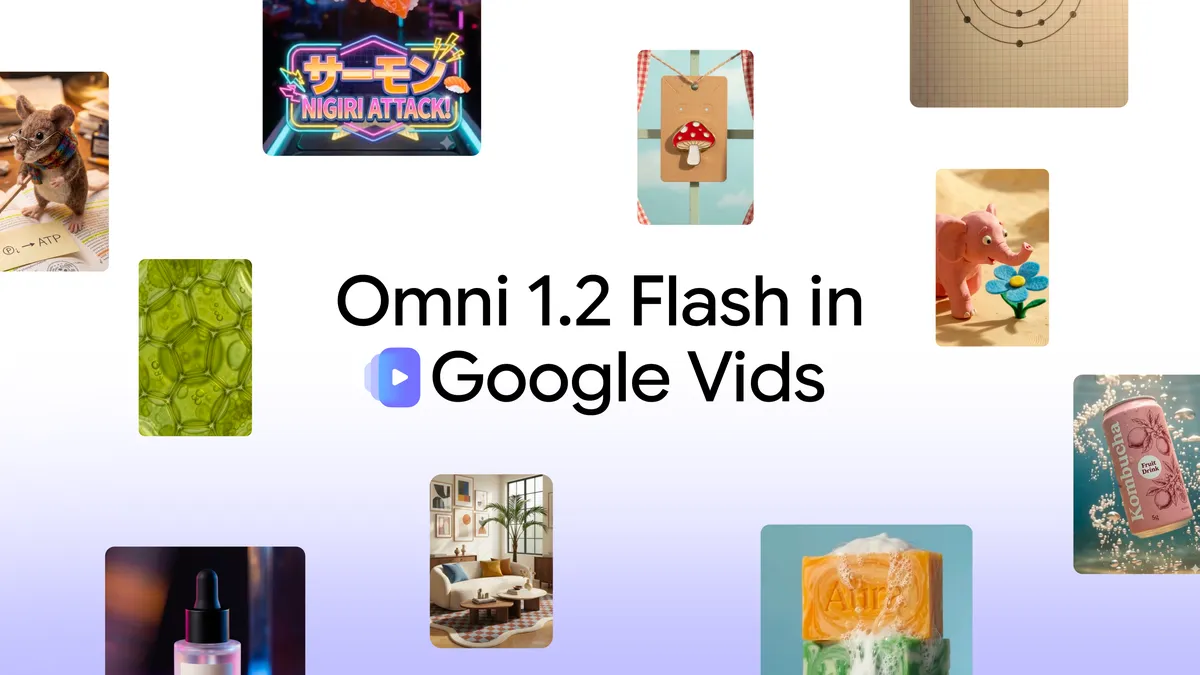
Google Vids can now generate AI video clips up to 15 seconds long using Gemini Omni 1.2 Flash, giving creators more room for a short demonstration or a complete promotional scene. Google announced the update on November 5, alongside a limited free generation allowance.
For a small business making social posts, the useful change is not just a longer timer. A single clip can potentially show a product, demonstrate one feature and leave space for a closing message without requiring several separately generated shots.
Key takeaways
- Google Vids supports clips of up to 15 seconds with Omni 1.2 Flash.
- Google advertises three free 15-second videos per month for Google account and Workspace users.
- API pricing is separate from the allowance inside Vids.
What changes inside Google Vids
In its Vids announcement, Google says the new model supports longer scenes, reference images and more natural narration. The company presents the update as useful for product promos, educational material and turning still images into moving scenes.
Those are Google’s descriptions of the capabilities. We have not independently tested the model, so claims about consistency or realism should be treated as vendor claims rather than measured results.
For creators, a sensible first experiment is a simple scene: one subject, one movement and one clear purpose. Adding several locations, speakers and camera transitions makes it harder to tell which part of a prompt needs changing when the output disappoints.
Free access has a defined limit
Google says people with a Google account or a Workspace subscription can generate up to three 15-second videos per month in Vids at no cost. That provides a way to try the workflow, rather than an unlimited production budget.
The Workspace rollout notice lists a November 5 start and a one-to-three-day visibility window for Rapid Release and Scheduled Release domains. It also describes duration control from three to 15 seconds and higher limits for AI Expanded Access licenses.
If the feature is missing, check the account and the current Vids availability information before assuming it has been removed. Product access and monthly limits are part of the buying decision, especially for a team planning recurring campaigns.
API costs belong to a different calculation
In its broader model announcement, Google quotes $0.07 per second for 720p API video, a 30% reduction from Omni 1.1. A 15-second generation at that quoted rate works out to $1.05.
That arithmetic covers one generation at the stated rate. A production budget should also account for rejected takes and any other billable processing. The price of a successful finished clip depends on how many attempts it takes to get there.
Google also describes conversational edits, allowing users to refine a clip through follow-up instructions. It acknowledges ongoing work on fast sports action, rapid script changes and complex physics.
What this means for product videos
Our analysis: reference fidelity is the most important thing to evaluate before using generated footage to sell something. A smooth video is less useful if a product’s proportions, labeling or operating behavior changes between frames.
Review the clip frame by frame around movement and transitions. Check that any displayed claim is accurate, that narration matches what appears on screen, and that viewers can understand the message with sound muted.
For example, a creator promoting a folding table could test one scene showing its intended use. The final review should check the legs, hinges and surface shape against the real product, rather than approving the output solely because it looks polished.
Frequently asked questions
Is Google Vids AI video unlimited for free?
No. The announced free allowance is limited. Check the account’s current limits before planning a batch of videos.
Does an API price apply to every Vids clip?
The API rate and Vids allowance describe different access routes. Choose the route that fits the workflow and review its applicable terms.
Explore more developments in Tech News Home’s AI coverage.
Primary sources: Google’s Vids announcement, Workspace rollout notice and model launch details, linked above.