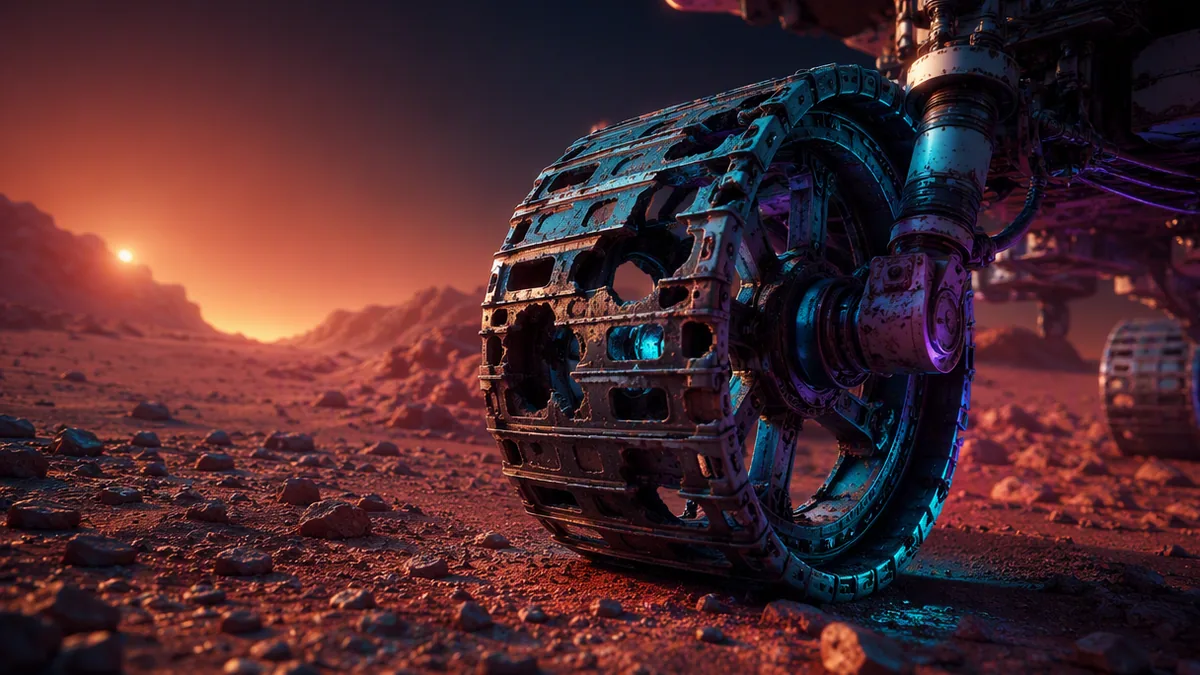
Fourteen years after landing on Mars, NASA’s Curiosity rover is still working, still climbing, and still sending home data. But the latest images of its wheels tell the real story of what a decade and a half on an unforgiving planet does to human engineering.
Twenty miles that feel like two hundred
On paper, 20 miles in 14 years sounds almost leisurely, barely four feet per hour of mission time. In practice, every inch was negotiated with a landscape that has no interest in being crossed. Mars offers no roads, no tow trucks and no replacement parts, only sharp volcanic rock, sand traps that swallow traction, and temperature swings that fatigue metal cycle after cycle.
Curiosity’s aluminum wheels were engineered for exactly this abuse, and the fact that the rover still rolls after 14 years is a testament to the design. But the photography is sobering. Jagged punctures perforate the wheel skins, and entire sections of tread have torn away. NASA’s own assessment is blunt: a particularly sharp obstacle, wedged at the wrong angle, could immobilize the rover.
Engineering around the damage
What makes this story genuinely impressive is not the damage but the response. Since engineers first spotted unexpected wear in 2013, wheel inspections became a routine part of rover operations. The team redesigned drive paths to avoid the worst terrain, trading direct routes for survivable ones. They also developed traction control software that adjusts each wheel individually, reducing the grinding forces that tear aluminum against stone.
This is spacecraft engineering at its best: not building something indestructible, but building something whose degradation is observable, predictable and manageable. Every hole in those wheels was logged, modeled and folded back into operational planning. The rover’s scars are, in effect, a 14 year materials science experiment conducted 140 million miles from the lab.
A mission with no end date
Perhaps the most remarkable detail is NASA’s decision to extend Curiosity’s mission indefinitely. There is no final destination, no planned shutdown. The agency will operate the rover until hardware failure ends the mission naturally. Given the state of the wheels, that ending is no longer hypothetical, but nobody is scheduling it either.
Curiosity remains scientifically productive: analyzing rock chemistry, tracking methane fluctuations, photographing a landscape no human has touched. Its younger sibling Perseverance gets the headlines with sample caching, but Curiosity’s longevity is its own kind of discovery, proof that robotic exploration can be a marathon rather than a sprint.
Why it matters down here
The lessons from those battered wheels feed directly into future rover designs, lunar vehicles and, eventually, the machines that will support crewed missions. Materials fatigue, traction algorithms and route planning AI all trace lineage to Curiosity’s odometer. For a closer look at how AI is reshaping exploration and industry alike, see our coverage of the fruit fly connectome learning Doom and the record chip revenues driven by AI demand.
What fourteen years of science bought us
It is easy to focus on the hardware scars and forget why the rover is there. Curiosity’s climb through Gale crater and up the slopes of Mount Sharp rewrote our understanding of Martian history: ancient lakebeds with the chemistry to support microbial life, organic molecules preserved in rock, and methane readings that pulse in patterns scientists still debate. The rover essentially demonstrated that Mars was not merely wet in the distant past but persistently habitable by the standards we know. Every sample drilled and every panorama shot adds resolution to that picture.
The road ahead for Mars exploration
Curiosity’s endurance also frames the program’s next chapter. Perseverance is caching samples for a future return to Earth, orbiters continue to map ice and minerals, and every design team working on future rovers studies Curiosity’s wear data like scripture. The wheels are the visible cost, but the invisible dividend is knowledge: how materials fatigue in perchlorate laced dust, how autonomous navigation copes with degraded traction, how long a nuclear powered science platform can stay productive. When the rover finally stops, it will not have failed. It will have finished the longest field test in planetary science.
How NASA keeps a 14 year old rover alive
Behind the wheel photos sits an operational discipline that deserves its own credit. Curiosity is nuclear powered, which frees it from the dust and daylight constraints that ended solar powered missions, but every other system ages. The operations team on Earth has spent years writing software updates that compensate for worn components, rehearsing drives in a Mars yard replica before committing to them, and rationing the use of anything that degrades with motion. When a drill misbehaves, they invent a new way to drill. When wheels tear, they rewrite route planning. The result is a machine that has outlived its primary mission by more than a decade while doing some of its best science late in life, high on the slopes of Mount Sharp where the rock records Mars’ transition from wet to dry.
There is something quietly moving about the whole situation. A machine designed for a primary mission of one Martian year has spent fourteen teaching us, and its operators have responded by refusing to set an end date. The wheels will decide when the mission is over. Until then, every meter Curiosity gains on that battered hardware is a small argument for building things to be repaired, adapted and kept running, on a planet where nobody can.
Source: NASA Mars Exploration Program, Curiosity mission updates (2026).
Space fan with questions or photo tips? Contact the newsroom via our Contact page.