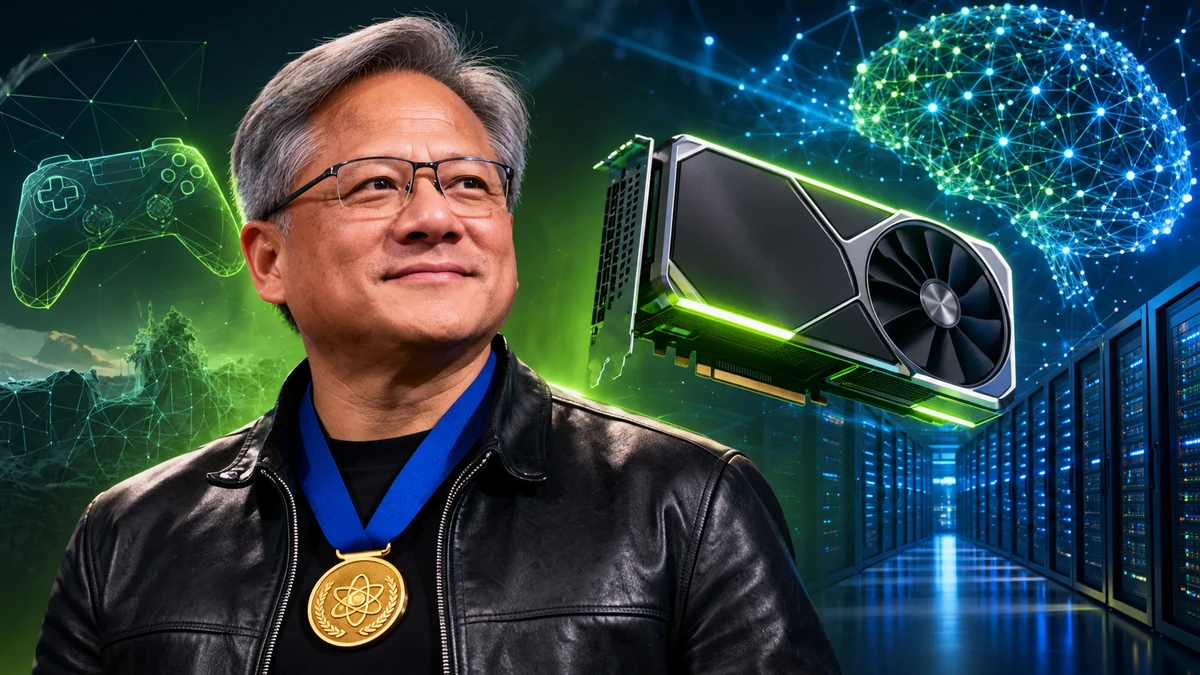
NVIDIA founder and CEO Jensen Huang has received the National Medal of Science, one of the United States’ highest scientific honors, for helping transform graphics processing units (GPUs) into powerful engines for artificial intelligence and scientific computing.
President Donald Trump presented the award on October 8, 2026, during the Science: A New Golden Age summit in Washington, D.C.
The recognition highlights one of computing’s most consequential technological transformations: hardware once primarily associated with rendering video games has become essential infrastructure for developing AI systems, running complex simulations, and accelerating scientific research.
The honor also coincided with NVIDIA announcing $1 billion in commitments over five years to support American scientific research.
Key Takeaways
- Jensen Huang received the National Medal of Science on October 8, 2026, recognizing advances in GPU-based computing.
- NVIDIA’s CUDA platform, introduced in 2006, helped make GPUs practical for applications far beyond gaming.
- AMD CEO Lisa Su, Google co-founder Sergey Brin, and Elon Musk also received National Medals of Science.
- NVIDIA separately announced commitments valued at $1 billion over five years for U.S. scientific research, including AI and quantum computing.
- The ceremony did not introduce a new GPU, pricing structure, or independently verified performance benchmarks.
Why Jensen Huang Received the National Medal of Science
The White House’s official announcement identifies Huang’s contributions to general-purpose GPU computing as the central reason for his selection.
His official citation recognizes advances in processor design and software that expanded GPUs into computing architectures capable of supporting scientific workloads and artificial intelligence.
That distinction matters.
Huang was not recognized for creating the fastest gaming graphics card or introducing a particular AI processor. The award acknowledges a broader technological contribution that unfolded over decades.
Established by Congress in 1959, the National Medal of Science recognizes outstanding contributions to scientific and engineering knowledge.
Huang joined three other recipients of the science medal:
| Recipient | Recognized contribution |
|---|---|
| Jensen Huang, NVIDIA | General-purpose GPU computing and parallel processing |
| Lisa Su, AMD | Semiconductor architecture and high-performance computing |
| Sergey Brin, Google | Information retrieval algorithms and data processing |
| Elon Musk, SpaceX | Engineering advances in space and intelligent systems |
Microsoft CEO Satya Nadella and Dell Technologies founder Michael Dell received the separate National Medal of Technology and Innovation.
Together, the recipients reflect the growing importance of computing infrastructure, semiconductor engineering, and software in scientific progress.
How Gaming GPUs Became Essential to Artificial Intelligence
The technical breakthrough behind Huang’s award was not simply making graphics processors faster.
It involved changing what computers could do with them.
Traditional CPUs are designed to handle a wide variety of instructions, including complex tasks that must be executed in sequence.
GPUs take a different approach. They contain many processing units capable of performing large numbers of similar calculations simultaneously.
That parallel architecture is particularly valuable for AI, where training neural networks involves repeatedly performing mathematical operations on enormous collections of numerical data.
However, powerful hardware alone was insufficient.
Developers needed accessible programming tools to run scientific applications without treating the graphics processor primarily as a graphics-rendering device.
NVIDIA addressed that challenge through CUDA, its parallel computing platform introduced in 2006.
According to NVIDIA’s CUDA documentation, the platform enables developers to use GPUs for general-purpose computing.
Over time, GPU acceleration became important in scientific simulations, computational biology, machine learning, and other demanding applications.
The emergence of deep learning further increased demand for massively parallel processing.
Modern AI infrastructure is therefore the result of both hardware engineering and a mature software ecosystem.
That combination, rather than gaming performance alone, explains NVIDIA’s position in today’s AI industry.
Gaming GPUs vs. Data-Center AI Accelerators: What Actually Changes?
Consumer graphics cards and enterprise AI accelerators share important architectural ideas, but they are designed around different requirements.
| Technology | Primary purpose | Major advantage | Important limitation |
|---|---|---|---|
| Traditional CPU | General-purpose computing | Flexible execution and strong sequential processing | Less efficient for many highly parallel AI calculations |
| Consumer NVIDIA GeForce GPU | Gaming, graphics, content creation, and compatible AI workloads | Parallel processing with accessible developer tools | Memory capacity and sustained compute capacity can limit large AI workloads |
| Data-center NVIDIA GPU | AI training, inference, and scientific computing | Designed for large-scale compute, high-bandwidth memory, and accelerator interconnection | Significant infrastructure, energy, cooling, and deployment costs |
An enthusiast gaming GPU can run smaller AI models locally, provided sufficient memory and compatible software are available.
Training advanced models at industrial scale is a substantially different challenge.
Those workloads may require interconnected accelerators, specialized networking, large memory pools, and extensive data-center infrastructure.
It’s also important to avoid treating NVIDIA’s success as proof that all AI workloads must use its hardware.
AMD accelerators, Google’s specialized AI processors, and other computing architectures provide alternatives depending on software compatibility, workload characteristics, and deployment requirements.
Performance and pricing clarification: The October 8 medal announcement was not a product launch. It provided no new GPU specifications, independent benchmarks, hardware availability dates, or retail prices. API rates, subscription fees, caching charges, and customer discounts are not applicable to the award itself.
NVIDIA Announces $1 Billion in Scientific Research Commitments
The ceremony coincided with another significant NVIDIA announcement.
In an official October 8 press release, the company disclosed commitments valued at $1 billion over five years to strengthen U.S. scientific research capabilities.
The initiative includes support for university research institutions, quantum computing development, and cloud infrastructure serving government research needs.
NVIDIA also identified scientific areas such as healthcare, energy security, and materials research as potential beneficiaries of advanced AI infrastructure.
The announcement is connected to the U.S. government’s Genesis Mission, which seeks to apply advanced computing and AI tools to scientific discovery.
There is an important financial distinction, however.
The announced $1 billion represents commitments valued at that amount, not necessarily a $1 billion cash grant.
NVIDIA has not provided a complete public, itemized breakdown establishing precisely how much of that total consists of direct funding, computing resources, infrastructure investments, or other forms of support.
Detailed allocation schedules and measurable research outcomes also remain to be established.
For universities and research laboratories, access to computing resources could prove particularly valuable.
Advanced AI research requires more than sophisticated algorithms. Scientists also need hardware capacity, appropriate datasets, engineering support, and reliable access to computing infrastructure.
Whether the commitments deliver meaningful benefits will ultimately depend on implementation, accessibility, and independently measurable scientific results.
Why This Award Matters Beyond NVIDIA
Huang’s recognition illustrates how deeply graphics technology has influenced modern computing.
The gaming market helped establish demand for progressively more capable graphics processors. Software advances subsequently made that processing power useful across scientific and commercial applications.
Today, GPU acceleration helps support everything from molecular modeling to AI-assisted software development.
For researchers, the main opportunity is potentially faster experimentation and access to computational techniques that would otherwise require substantial infrastructure.
For businesses, the lesson is different: choosing an AI computing platform requires evaluating software compatibility, memory requirements, deployment expenses, and long-term flexibility—not simply comparing peak performance claims.
For PC gamers, the award does not indicate an immediate change in GeForce availability, graphics card pricing, or gaming performance.
There are also unresolved challenges.
Advanced AI hardware depends on energy-intensive infrastructure, sophisticated manufacturing, specialized memory, and complex supply chains. Furthermore, reliance on a dominant software ecosystem can create switching costs for developers.
The medal recognizes an influential computing achievement, but it is not an independent endorsement of NVIDIA’s current products or commercial practices.
Readers following developments in processors, graphics cards, and AI infrastructure can find additional technology coverage at TechNewsHome.
Ultimately, Jensen Huang’s National Medal of Science recognizes a transformation much bigger than one company or product generation.
Graphics processors evolved from specialized rendering hardware into a fundamental component of modern AI and scientific computing. The next challenge is ensuring that those capabilities translate into affordable, accessible, and measurable advances beyond the data center.
Frequently Asked Questions
1. Why did Jensen Huang receive the National Medal of Science?
He was recognized for advances in GPU architecture and software that helped establish graphics processors as powerful tools for scientific computing and artificial intelligence.
2. What role did NVIDIA CUDA play in the AI revolution?
CUDA, introduced in 2006, provided programming tools that made NVIDIA GPUs more accessible for general-purpose parallel computing, including machine learning and scientific simulations.
3. Did NVIDIA announce a new GPU or a $1 billion cash donation?
No new GPU was announced as part of the medal presentation. Separately, NVIDIA disclosed $1 billion in commitments valued over five years, without a complete public breakdown identifying the entire amount as cash funding.
Official Sources and Further Reading
- The White House — President Trump Presents National Medals of Science and Technology and Innovation (October 8, 2026) — Official recipients and award citations.
- U.S. National Science Foundation — National Medal of Science — Award history, eligibility, and recognition criteria.
- NVIDIA Developer — CUDA FAQ — Technical background on general-purpose GPU computing and CUDA’s development.
- NVIDIA Newsroom — NVIDIA Commits $1 Billion to Advance U.S. Science Over Five Years (October 8, 2026) — Official research commitment and announced areas of support.